CEMEX
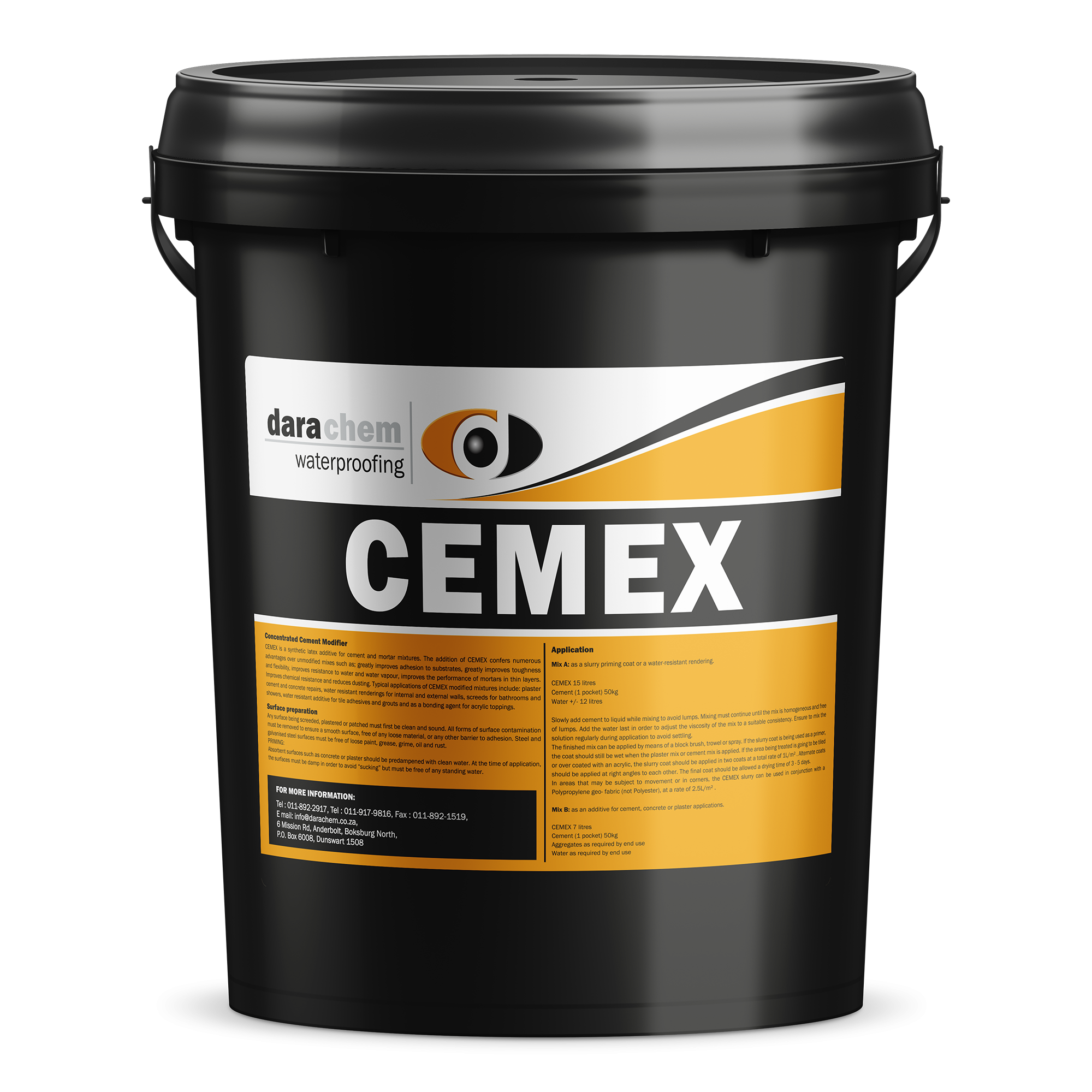
CEMEX Cementmodifier Discussion CEMEX is a synthetic latex additive for cement and mortar mixtures. The addition of CEMEX confers numerous advantages over unmodified mixes such as; greatly improves adhesion to substrates, greatly improves toughness and flexibility, improves resistance to water and water vapour, improves the performance of mortars in thin layers. Improves chemical resistance and reduces dusting. Typical applications of CEMEX modified mixtures include: plaster cement and concrete repairs, water resistant renderings for internal and external walls, screeds for bathrooms and showers, water resistant additive for tile adhesives and grouts and as a bonding agent for acrylic toppings. Physical Properties Colour: Wet: White milky liquid. Dry: Translucent/clear Pack Size: 25L Application: Admixture Total Solids: ± 35% Specific gravity: ± 1.0 Viscosity: 110 cps Units at 20ºC Drying Time: 12 hours between coats Full cure: 3-5 days Cleaning: Water when wet. Ethyl acetate when dry. Flammability: Non-Flammable Surface preparation Any surface being screeded, plastered or patched must first be clean and sound. All forms of surface contamination must be removed to ensure a smooth surface, free of any loose material, or any other barrier to adhesion. PRIMING: Porous surfaces such as concrete, plaster or brickwork should be pre-dampened with clean water. At the time of application, the surfaces must be damp in order to avoid “sucking” but must be free of any standing water. Technical assistance and applicator training are freely available to all approved users. Application Mix A: as a slurry priming coat or a water resistant rendering CEMEX 15 litres Cement (1 pocket) 50kg Water ± 12 litres Slowly add cement to liquid while mixing to avoid lumps. Mixing must continue until the mix is homogeneous and free of lumps. Add the water last in order to adjust the viscosity of the mix to a suitable consistency. Ensure to mix the solution regularly during application to avoid settling. The finished mix can be applied by means of a block brush. If the slurry coat is being used as a primer, the coat should still be wet when the plaster mix or cement mix is applied. If the area being treated is going to be tiled or over coated with an acrylic, the slurry coat should be applied in two coats at a total rate of 1L/m2. Alternate coats should be applied at right angles to each other. The final coat should be allowed a drying time of 3 - 5 days. In areas that may be subject to movement or in corners, the CEMEX slurry can be used in conjunction with a POLYVELD membrane, at a rate of 2.5L/m2. The slurry coat should not be exposed to UV’s. Mix B: as an additive for cement, concrete or plaster applications. CEMEX 7 litres Cement (1 pocket) 50kg Aggregates as required by end use Water as required by end use Note drying times are based on a temperature of 25℃ min. and a R.H. of 60% max.
Maintenance No maintenance required. Health and Safety • Avoid contact with skin or eyes. • Keep out of reach of children. • If accidently swallowed, seek medical advice immediately. • To avoid the risk of spillage, always store and transport containers in a secure upright position. • Refer to Material Safety Data Sheet for additional information. Standard Disclaimer The recommendations contained herein are given in good faith and meant to guide the specifier or user in accordance with good painting practices. They are gained from our tests and experiences and are believed to be accurate and reliable. No warranty/guarantee is implied by the recommendations contained herein since the conditions of use; application method, substrate and cleanliness of the substrate are beyond STT Sales (PTY) LTD control. Where other products are to be used in conjunction with this material, the relevant technical data sheets should be consulted to determine total requirements. Important Note: It is the responsibility of the user to ensure that the latest TDS is being used for reference. DARACHEM Data Sheets are available on our website www.darachem.co.za or Email info@darachem.co.za. Updated February 2025 (This supersedes all previous publications).